A Complete Guide into Yield-Bearing Stablecoins


Why Yield-Bearing Stablecoins?
Stablecoins have become the backbone of DeFi thanks to their predictable value pegged to the dollar, making them ideal for transfers, trading, and savings. They were among the first real-world assets (RWAs) tokenized on-chain, paving the way for the recent surge in tokenized assets across the ecosystem. As the space evolves, so do stablecoins — now with the potential to generate yield.
In today’s macro environment, where U.S. T-Bills offer yields between 3% and 5%, simply holding regular stablecoins means losing ground to inflation and incurring an opportunity cost by missing out on potential earnings. Yield-bearing stablecoins address this gap by combining dollar stability with a built-in income stream. Beyond preserving capital, they can serve as productive collateral in DeFi, helping offset costs like funding rates on perpetual positions and improving the efficiency of idle cash.
Yield-bearing stablecoins are built on different mechanisms — ranging from delta-neutral trading strategies to fully backed T-Bill structures. They enable users to earn passive income without sacrificing their peg to the dollar. However, it’s important to understand that these assets carry a negatively asymmetric risk profile: while upside gains are limited to steady yields (typically low-to-mid single digits), downside risks can be significant in extreme events such as protocol failure or collateral default — much like traditional bonds or cash instruments.
Not all yield-bearing stablecoins are created equal. They differ widely in how they maintain their peg, where their yields come from, and the risks involved. This article provides a framework to evaluate them and offers four recommendations, each representing a distinct balance between yield and risk.
How to Analyze Yield-Bearing Stablecoins: A Deep Dive Into Design
Yield-bearing stablecoins can be assessed by understanding how they work across five dimensions:
1. Peg Stability Mechanism
The defining feature of any stablecoin is its ability to maintain a stable value — pegged to the US dollar or other fiat currency. Understanding the peg mechanism helps us assess how sustainable the mechanism is and how it would behave under stress conditions.
The peg is directly influenced by the type of collateral used. When a stablecoin is backed by USD-denominated assets like T-Bills, tokenized money market funds, or dollar-based strategies, the peg is inherently easier to achieve, as the underlying assets themselves are already USD dollar denominated.
However, when the collateral includes volatile assets like ETH or BTC, price fluctuations introduce risk. The first models of stablecoins backed by volatile assets resembled collateralized debt positions, where the user posts volatile collateral and receives a loan in the form of a stablecoin, facing potential liquidation if the collateral’s value drops.
More recently, a new generation of models has emerged as a more user-friendly evolution of those earlier systems, introducing delta-neutral strategies. In these designs, the protocol maintains exposure to volatile collateral but simultaneously opens short positions in perpetual futures to hedge price fluctuations — effectively neutralizing market exposure and delivering a stable dollar-denominated output.
Peg resilience also depends on additional mechanisms like overcollateralization, insurance reserves, or even legal recourse. These tools act as layers of defense to protect the peg during adverse conditions. Overcollateralization ensures a safety buffer in case of collateral drawdowns. Insurance funds can absorb losses in extreme scenarios. Legal structures or corporate wrappers may add enforceability and recourse, particularly in stablecoins with real-world assets or off-chain dependencies.
2. Yield Generation Models
There are multiple ways in which stablecoins can generate yield, and these mechanisms are not necessarily exclusive. In fact, many protocols combine more than one to optimize for sustainability and capital efficiency. However, most models in production today tend to fall into one of the following four core categories:
a) Delta-Neutral Structured (e.g., sUSDe by Ethena, stUSR by Resolv): Yield is generated from both sides of the delta-neutral position:
- Long Leg: These protocols hold the asset — typically ETH or BTC — but instead of holding the raw asset, they use LSTs (Liquid Staking Tokens) like stETH. These tokens represent staked positions and allow the protocol to capture staking yield while maintaining a liquid position.
- Short Leg: The protocol takes short positions on perpetual contracts. By doing so, it receives the funding rate paid by the traders going long. Historical data from Ethena shows funding rates on BTC and ETH pairs have been positive ~89% of the time over the past three years.
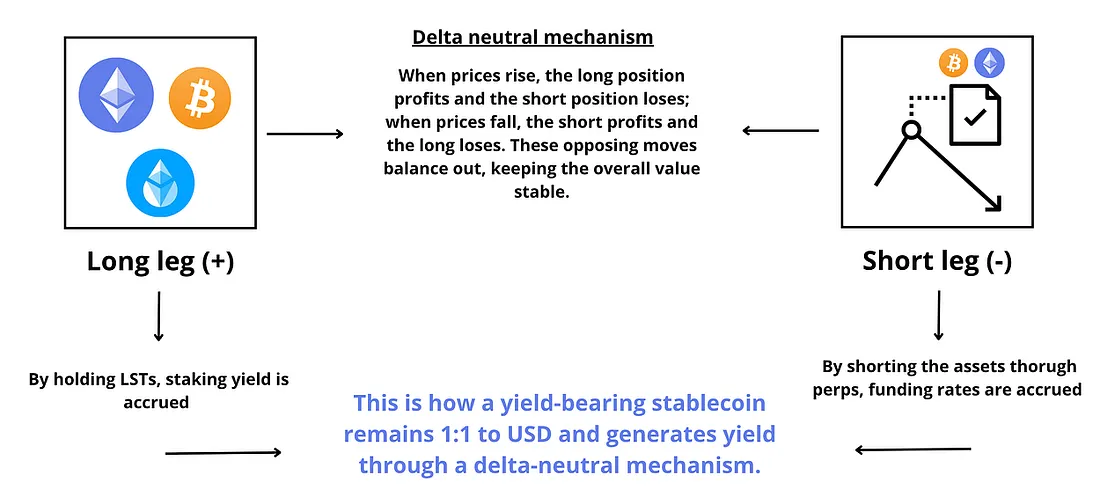
Funding rates are a key mechanism in perpetual futures markets. Unlike traditional futures, which have fixed expiries and can exhibit contango or backwardation, perps trade indefinitely and are designed to stay close to the spot price. When demand is higher for long positions in a bull market, perps tend to trade above spot and funding rates are positive — meaning longs pay shorts. In bearish markets, the reverse happens: perps may trade below spot, and funding rates turn negative, with shorts paying longs. This dynamic reflects market sentiment and becomes a key revenue stream on the short side of delta-neutral strategies.
b) Backed by USD-Denominated Assets (e.g., USDY by Ondo): These stablecoins are fully collateralized by real-world, dollar-denominated assets such as short-term U.S. Treasury Bills or tokenized money market funds. Protocols like Ondo use institutional custodians and offer tokenized access to government securities, passing the yield directly to holders of their stablecoin (e.g., USDY). This structure is generally considered the most secure, as it relies on low-risk, highly liquid sovereign debt and avoids crypto-native volatility.
c) Backed by USD-Denominated Strategies: This category includes stablecoins that generate yield through DeFi-CeFi strategies, as well as through institutional lending models — both fully USD-denominated but with important differences in structure and risk.
On one side, you have stablecoins like SyrupUSDC by Maple Finance. SyrupUSDC is backed by overcollateralized loans issued to real-world institutional borrowers. These loans are secured by blue-chip digital assets (e.g., BTC and ETH) and are underwritten using Maple’s conservative credit frameworks. While the capital flow happens on-chain, the counterparty risk is tied to identifiable institutions — making this a more hybrid model that bridges DeFi and traditional credit underwriting.
In contrast, tokens like stkScUSD from Rings Protocol and srUSD from Reservoir rely entirely on DeFi-native strategies. stkScUSD allows users to stake their scUSD into Veda Vaults, which automatically deploy capital across curated DeFi strategies including liquidity provisioning and lending. srUSD, issued by Reservoir, takes a similar approach by allocating capital across DeFi protocols such as Morpho, with regular Proof-of-Reserves audits to ensure transparency and solvency. These models are fully on-chain, permissionless, and tend to carry higher smart contract risk, but also offer yield diversification and deeper DeFi integration.
d) Sourced from Protocol Revenue Sharing: This category includes stablecoins that generate yield by distributing a portion of the protocol’s revenue to holders/stakers. The yield mechanisms are typically tied to interest paid by borrowers or other protocol income streams.
The most notable example here is sUSDS by Sky Protocol. sUSDS earns yield through the Sky Savings Rate (SSR), which is funded by a mix of fees from USDS borrowers, liquidation penalties, and investments in real-world assets such as U.S. Treasury bills. Rather than requiring users to stake or interact with separate modules, sUSDS accrues value passively over time through rebasing, functioning like a decentralized savings account.
scrvUSD, issued by Curve Finance, follows a similar logic but requires active participation. Users must deposit crvUSD into the scrvUSD module to earn interest derived from borrowing fees. The yield is governed by CurveDAO and designed to be low-risk, relying solely on protocol-level borrower activity without rehypothecation or external yield chasing.
A comparable model is stkGHO from Aave. Here, yield comes from interest paid by users who mint GHO. Those who hold stkGHO share in the protocol’s earnings, and additional incentives are granted to users who stake AAVE into the Safety Module (stkAAVE), offering reduced borrowing costs. This structure ties yield directly to protocol usage and governance.
Together, these stablecoins represent a model where returns are not dependent on external trading or lending but are instead sustainably sourced from the economic activity within the protocol’s own ecosystem.
3. Yield Accrual Mechanism
Yield accrues in two primary forms:
- Rebasing Tokens: User balances increase periodically (e.g., rUSDY).
- Appreciating Tokens: Token price increases but quantity is fixed (e.g., USDY).
Some stablecoins offer both forms simultaneously by issuing wrapped versions. For example, protocols may offer a rebasing token for direct income accrual and a non-rebasing, appreciating version (e.g., wstUSR) better suited for integrations or capital efficiency in DeFi applications.
The choice affects tax liabilities in some jurisdictions, as rebasing may be taxed on receipt, while appreciation defers taxation until tokens are sold — mirroring distribution vs. accumulation ETFs in traditional finance.
4. Operational Risk Considerations
Operational risk varies significantly across stablecoin models and is a critical component of yield sustainability.
Delta-neutral strategies, for instance, rely on sophisticated execution: opening and maintaining hedges, managing funding rate exposure, and operating across multiple centralized exchanges and protocols. These dependencies introduce risk at every layer — exchange reliability, oracle accuracy, margining practices, and even slippage during rebalancing.
Stablecoins using DeFi-native strategies face smart contract vulnerabilities, yield volatility, or third-party protocol failures. Lending-based stablecoins carry borrower default risk, while those relying on tokenized funds or real-world assets must trust off-chain custodians and NAV calculation processes.
The best way to assess operational risk is to map potential failure points and then evaluate the controls in place. These include overcollateralization thresholds, insurance and reserve funds, and contingency mechanisms. Transparency dashboards, real-time metrics, or regular audits provide users with ongoing visibility into these systems.
Finally, a key lens is third-party reliance. Stablecoins with exposure to centralized exchanges for hedging (e.g., Ethena, Resolv), or DeFi yield aggregators and vault strategies (e.g., Rings, Reservoir) are only as resilient as the weakest link in their stack. Understanding who operates what, and how risk is distributed, is essential when assessing the long-term reliability of these systems.
5. Transparency Standards
Transparency is non-negotiable — especially in an asset class as structurally delicate as stablecoins. Without transparency, proper risk assessment becomes nearly impossible. Yield-bearing stablecoins inherently carry more complex dynamics than traditional stablecoins, and the level of required transparency should be directly proportional to the operational complexity and reliance on third parties.
Protocols that depend on delta-neutral execution or diversified DeFi strategies introduce additional risk layers and thus demand greater visibility. Transparency empowers users to evaluate the strength of a protocol’s peg, collateral backing, and operational integrity.
Leading examples like Ethena and Resolv set the gold standard. Their dashboards provide near real-time updates on total backing, asset composition, peg stability, venue allocation (e.g., Binance, Bybit), protocol TVL, and even short position exposure and funding rates. Ethena, for example, offers detailed collateral allocation breakdowns (BTC, ETH, LSTs), reserve ratios, system health metrics, and third-party audits and attestations via Chainlink, Chaos Labs, and LlamaRisk.
Similarly, Resolv displays transparent backing between its stablecoin (stUSR) and reserve layer (RLP), showing the collateral mix (ETH, BTC, stables), exchange distribution, APR breakdowns, and custody splits between DeFi protocols and institutional custody solutions. They also disclose risk concentration by venue and asset, allowing users to monitor exposure in real time.
Crucially, both protocols incorporate periodic on-chain proofs of reserve and custodial attestations, paired with clear third-party integrations and historical funding analytics. This allows users and integrators alike to monitor evolving protocol health — not just at a snapshot in time, but continuously.
In short, transparency is the foundation of risk-aware stablecoin adoption. If the protocol does not disclose the data necessary to verify backing, assess counterparty exposure, or validate the sustainability of its yield, it should be disqualified from serious consideration.
My Top Yield-Bearing Stablecoin Picks: A Risk-Adjusted View
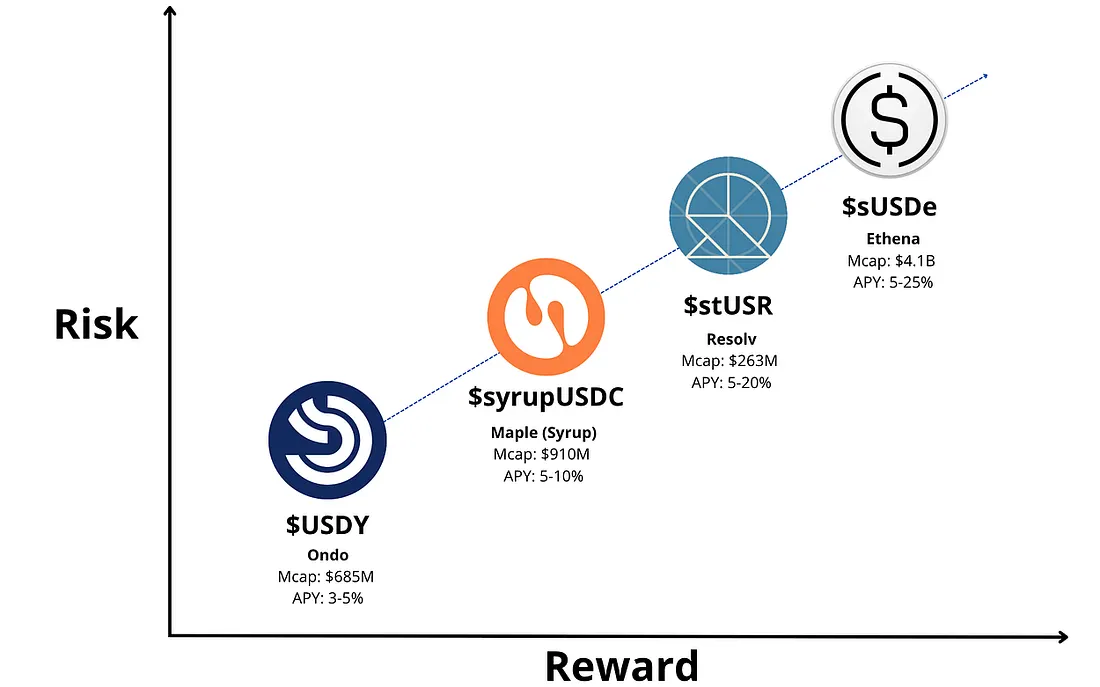
Across the broad landscape of yield-bearing stablecoins, I’ve selected four that stand out as archetypes — each representing a different yield model, peg mechanism, and risk profile. These are not just illustrative but represent my personal recommendations based on deep research, protocol design, transparency standards, and risk-adjusted performance.
sUSDe (Ethena)
sUSDe is the staked version of USDe, a synthetic dollar issued by Ethena. The protocol is overcollateralized (currently around 101%) and uses a delta-neutral strategy to preserve its peg and generate yield. Yield is distributed only to those who stake USDe, receiving sUSDe in return — an automatically rebasing token that accrues rewards over time.
The delta-neutral trade involves two sides. On the long leg, Ethena holds a mix of assets including ETH (14%), BTC (38%), ETH LSTs (6%), SOL (1%), and liquid stablecoins (41%) such as USDT, USDC, sUSDS, and notably USDtb. USDtb is issued by Ethena itself and is backed 90%+ by BUIDL, BlackRock’s tokenized T-Bill fund, making Ethena its largest LP.
On the short leg, Ethena opens perp contracts on leading centralized exchanges (Binance, Bybit, OKX, Deribit) to hedge market exposure and capture funding rates. These rates have historically been positive in bullish markets, allowing Ethena to extract yield from traders going long.
Importantly, the collateral mix is dynamic. In response to market conditions — especially during periods of negative funding — Ethena has increased its allocation to stablecoins, reducing exposure to volatile assets and moderating risk. As a result, yields that previously reached 25%+ during bullish runs have normalized to around 10% APY today.
The primary risks include:
- Reliance on CEXs for perp exposure (custodial + operational risk)
- Sensitivity to funding rate reversals
- Relatively small insurance fund compared to total TVL
Despite these risks, Ethena is the leading player in delta-neutral stabelecoins design, backed by top-tier investors like Dragonfly, Binance Labs, and Galaxy.
stUSR (Resolv Protocol)
stUSR is the yield-bearing version of USR, issued by Resolv Protocol, using a delta-neutral design to balance price exposure while offering a more conservative structure than its peers. Yield is generated through a combination of rewards from assets like ETH LSTs or USCC, and funding rate capture from perpetual short positions.
Resolv’s current collateral mix includes 41.7% in Bitcoin (primarily BTC and WBTC), 36.8% in Ether (including LSTs like wstETH, wbETH, weETH, and apxETH), and 21.6% in stablecoins — most notably USDC and USCC, the latter being a tokenized T-Bill fund by Superstate. The strategic inclusion of USCC introduces a reliable real-world yield source, improving yield stability and enhancing peg durability.
The protocol operates with a ~198% collateralization ratio — well above the industry standard — backstopped by its RLP token, which functions as an insurance buffer. RLP absorbs funding risk and liquidation events, effectively insulating stUSR holders from direct volatility. Unlike USR, which is non-yielding, stUSR delivers yield in a rebasing format, with a wrapped (non-rebasing) version wstUSR also available.
Yields currently average around 10% APY, overperforming Ethena’s sUSDe.
This makes stUSR well-suited for users who prefer a more risk-conscious alternative in the delta-neutral space,potentially accepting slightly lower returns in exchange for deeper reserves and structural protection.
SyrupUSDC is a yield-bearing stablecoin built on top of Maple Finance’s institutional lending infrastructure. It provides users with fixed-rate exposure to overcollateralized loans issued to KYC’d institutional borrowers, directly on-chain. The model is specifically designed to deliver stablecoin APYs with robust borrower controls and risk management.
From a total collateral pool of $520M, roughly $360M is actively deployed across more than 40 short-term loans. These loans are overcollateralized by an average of 150% and primarily secured with BTC (76%), ETH (9%) and SOL (7%). The remaining ~$160M is deposited in protocols like Aave and Sky to provide additional short-term liquidity buffers and optimize idle capital deployment.
Maple’s underwriting framework rigorously screens borrowers based on on-chain and off-chain credit metrics, including counterparty financials, collateral transparency, and real-time health monitoring. The loan agreements are legally enforceable, and real-time risk monitoring ensures rapid response to market changes or deteriorating borrower profiles.
The current APY stands at approximately 9.1%, composed of 6.6% from actual yield generated through lending, plus an additional 3.5% from “drips” — an incentive program that accumulates over time and is converted into $syrup tokens. These tokens can boost overall returns depending on market demand and platform dynamics. Risk remains primarily limited to borrower defaults or smart contract vulnerabilities, rather than systemic market volatility.
SyrupUSDC is particularly well-suited for users seeking safer, yield-enhanced exposure to USDC through a regulated and operationally mature infrastructure.
USDY (Ondo Finance)
USDY is Ondo’s yield-bearing stablecoin, fully backed by short-term U.S. Treasuries, reverse repurchase agreements (repo), and bank deposits. These assets are managed through trusted custodians such as Morgan Stanley, StoneX, Pershing, and Silicon Valley Bank. This structure ensures a conservative and consistent income stream closely tied to risk-free U.S. interest rates.
USDY currently yields ~4.25% APY and has a circulating value of over $685M. It accrues interest daily, net of fees, and users can choose between an appreciating format (USDY) or a rebasing version (rUSDY), depending on tax treatment or integration needs.
The product is overcollateralized at ~115%, supported by a bankruptcy-remote structure, and publishes daily reserve attestations from third parties — ensuring full visibility into asset backing and NAV. USDY is widely used by DAOs, institutional investors, and treasuries looking for safe, yield-bearing dollar exposure with on-chain composability.
With strong legal safeguards, regulatory clarity, and robust transparency, USDY stands out as one of the safest yield-bearing stablecoins available today.
Conclusion: Yield Isn’t Free — But It Can Be Smart
As the ecosystem matures, users must look beyond yield and start doing risk-adjusted analysis:
- Understand the source of yield: Is it sustainable? Is it correlated with crypto markets?
- Evaluate peg and collateral stability: How resilient is the protocol to shocks?
- Match to your risk profile: Is this for idle cash, farming, or active portfolio strategy?
The right yield-bearing stablecoin for you depends on your priorities — whether it’s yield stability with lower but consistent returns, yield potential with higher but more volatile gains, or DeFi composability.