Is Your Liquidity Actually Working? How to Optimize Fees, Slippage, Depth & Buybacks

Launching a liquidity pool is relatively easy.
Building a pool that continues to work efficiently as trading activity grows is much harder.
A project can show $500,000 in liquidity on a dashboard and still give traders poor execution. Large trades may move the price too much. Capital may sit outside the ranges where most trading happens. Fees may look attractive on paper while producing little value relative to the capital deployed.
This is why we don’t look at liquidity as a single number at Trireme.
We look at how that liquidity actually performs.
The objective is not simply to add more capital to a pool. It is to make the existing market more efficient for traders, token issuers and treasury operations.
That means looking at four areas in particular: fees, slippage, depth and buyback execution.
Headline Liquidity Is Not Executable Liquidity
Imagine two pools both showing $500,000 in total liquidity.
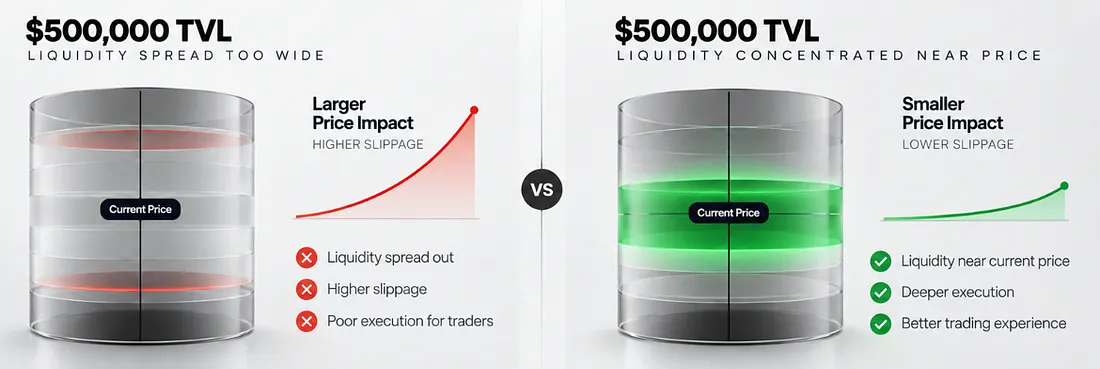
The first has a large percentage of that liquidity concentrated close to the current market price. A trader can execute a meaningful order without dramatically moving the market.
The second has the same headline liquidity, but much of the capital sits away from where trading is actually happening.
On a dashboard, the pools look similar.
To a trader, they can feel completely different.
This distinction becomes especially important on concentrated-liquidity AMMs, where the location of liquidity can matter just as much as the total amount deposited.
That is why our analysis begins with the actual trading experience.
What happens when someone executes $5,000? What about $25,000 or $50,000? How does the pool respond when volatility increases? How much usable depth exists around the active price?
Those questions tell us considerably more than TVL alone.
1. How We Approach Fee Optimization
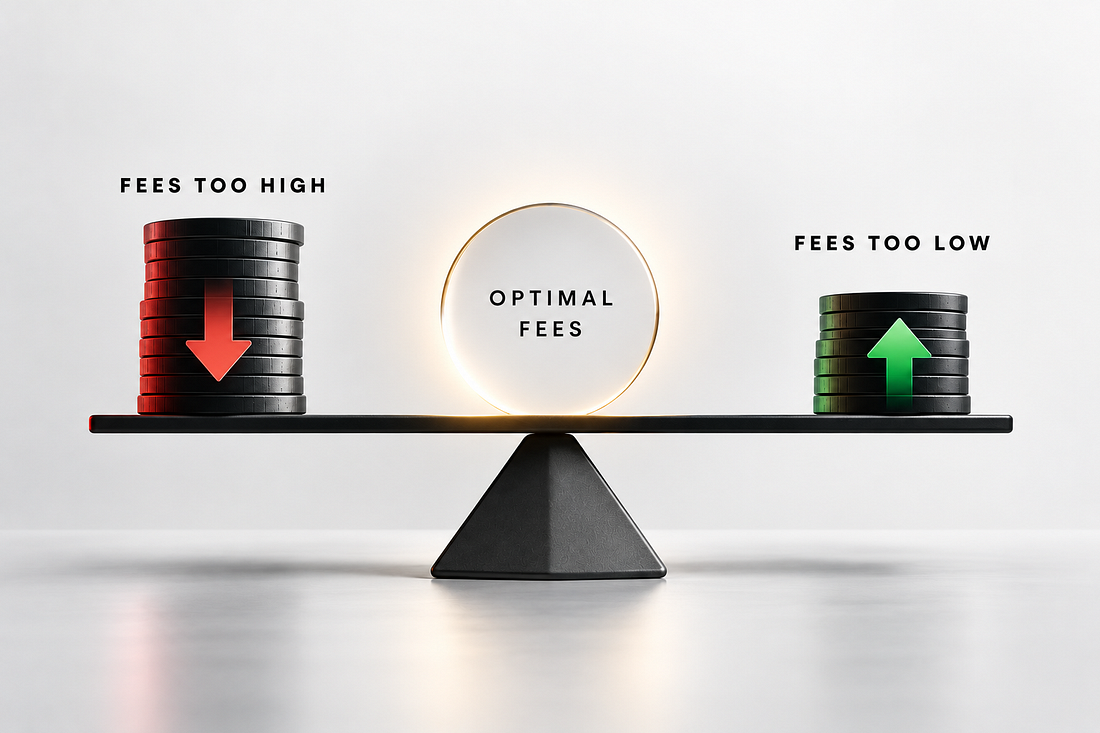
Higher fees do not automatically mean a better-performing pool.
Set fees too high and traders may route elsewhere. Set them too low and liquidity providers may not be adequately compensated for the risk and capital they provide.
The goal is to find a structure that makes sense for the actual market.
At Trireme, we would begin by analyzing trading activity, volatility, pool utilization, liquidity concentration and how frequently liquidity needs to be repositioned.
We would also look at where trades are being routed.
If another venue consistently provides better execution, simply increasing liquidity may not solve the problem. The pool needs to become competitive from an execution perspective.
Our approach is therefore to evaluate the relationship between:
Trading volume → capital deployed → execution quality → fees generated
Rather than maximizing one variable, we want the overall structure to work efficiently.
As market conditions change, that structure may need to change with them.
2. How We Reduce Slippage
Slippage tells us what happens between the price a trader expects and the price they actually receive.
If a relatively small order moves the market significantly, the pool may have a liquidity problem even if its TVL looks healthy.
Our first step would be to measure price impact across different trade sizes.
For example, we can model what happens when someone executes:
$5K $10K $25K $50K $100K
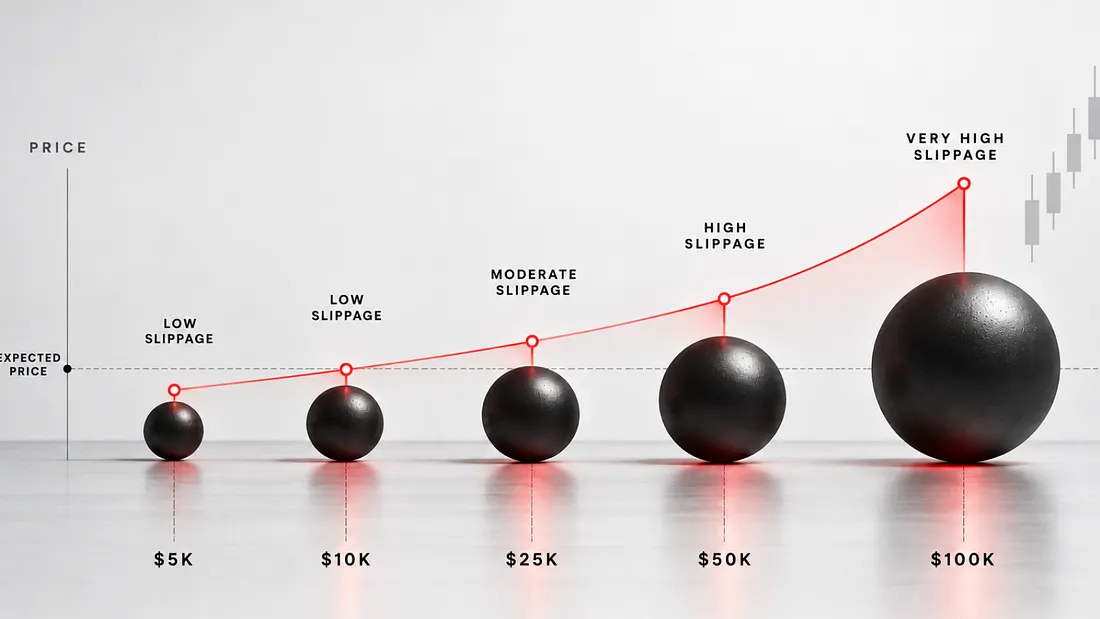
The objective is not to claim that every trade can execute at zero slippage. That is unrealistic.
Instead, the analysis shows where execution begins deteriorating and why.
If the problem comes from insufficient usable liquidity near the current price, we can look at liquidity positioning.
If the problem comes from fragmented liquidity across multiple venues, the solution may require looking at the market as a whole rather than one pool.
And if volatility is responsible, liquidity parameters may need to account for the changing market environment.
This is why slippage is one of the clearest measures of whether liquidity is actually doing its job.
3. How We Build Better Market Depth
This is where the difference between more liquidity and better liquidity becomes especially important.
Suppose a project has $1 million available for liquidity.
Putting the entire $1 million into a pool does not automatically produce the best market.
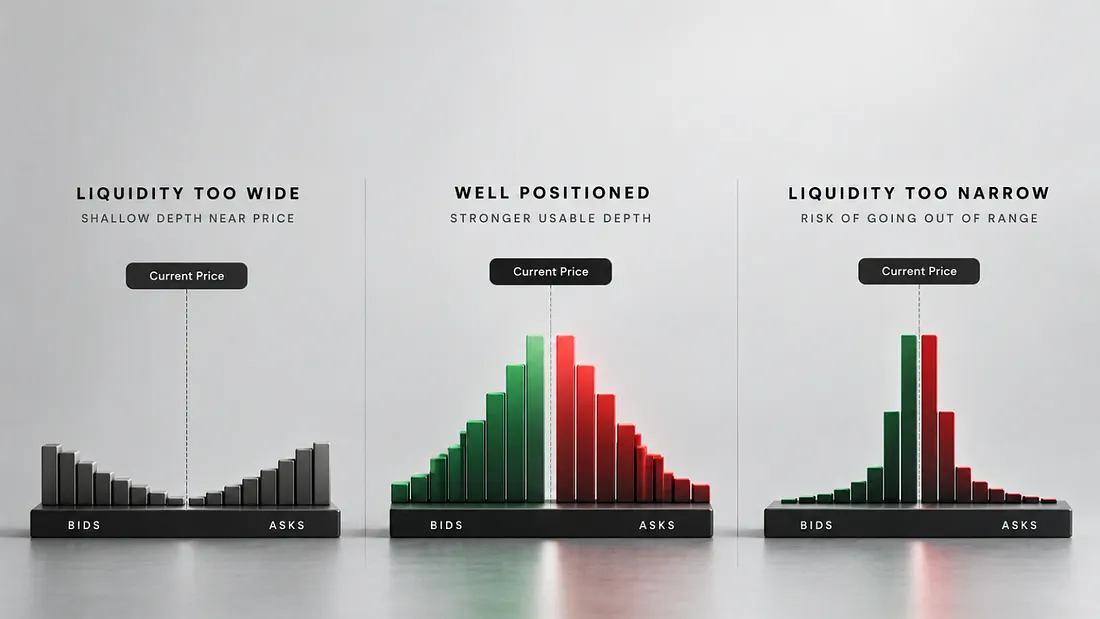
What matters is where that capital sits relative to the current price and expected trading activity.
For concentrated-liquidity pools, capital positioned closer to the active trading range can potentially provide substantially more usable depth than the same capital spread across a very wide range.
But tighter concentration also introduces trade-offs.
Liquidity can move out of range faster. Inventory exposure changes. Positions may require more active management.
So our strategy is not simply:
Concentrate everything near the current price.
It is to determine an appropriate liquidity structure based on the token’s volatility, volume, inventory, expected order sizes and market conditions.
We then monitor how that depth changes as the market moves.
A pool that worked well at launch may not be properly configured three months later.
Liquidity management therefore needs to be dynamic rather than static.
4. How We Approach Buybacks
Buybacks are often discussed as a treasury decision.
They are also an execution problem.
A project may decide to repurchase $100,000 of its token, but the market impact of that $100,000 depends heavily on available liquidity.
Executing too aggressively into a shallow market can create unnecessary price impact. It can also make treasury execution less efficient.
Before designing an execution approach, we would first assess the market.
How much depth exists?
What trade sizes can the market absorb?
How volatile is the token?
How fragmented is liquidity across venues?
What is the project’s actual treasury objective?
From there, execution can be structured around market conditions rather than treating the entire allocation as one trade.
That could involve breaking execution into smaller orders, adjusting participation based on available liquidity, monitoring slippage and coordinating execution across appropriate venues where relevant.
The goal is straightforward:
Execute the treasury’s mandate while managing market impact and execution costs.
A buyback should not be judged solely by how much capital was deployed.
Execution quality matters too.
Liquidity Should Scale With the Market
The liquidity structure a project needs at $1 million in daily volume may look very different at $10 million.
As trading activity grows, the market has to grow with it.
That means continually monitoring depth, slippage, liquidity utilization, spreads where relevant, fee generation, inventory and execution across venues.
If volume increases but executable depth does not, traders may experience worse execution precisely when interest in the token is growing.
That can become a bottleneck.
For projects expanding from a DEX into additional DEXs or centralized exchanges, the problem becomes even more complex because liquidity is now fragmented across multiple markets.
At that point, liquidity should be treated as infrastructure rather than a one-time launch expense.
The Trireme Approach
Our role is not simply to put capital into a pool and leave it there.
We use market infrastructure and active liquidity management to understand how the market is functioning and where it can be improved.
We start by measuring the market as traders actually experience it.
Then we identify where the inefficiency comes from.
It might be liquidity placement. It might be insufficient depth. It might be fee configuration, fragmented markets, poor capital utilization or treasury execution.
Only then do we determine what should change.
The process becomes continuous:
Measure → Analyze → Optimize → Monitor → Rebalance
Because the objective isn’t to make the liquidity number on the dashboard look bigger.
It’s to build a market that works better.
Your Pool Is Live. Now Make It Work Harder.
Projects spend months preparing products, tokenomics, communities and launches.
Liquidity deserves the same level of attention.
If your pool already has capital but traders are still experiencing high slippage, shallow depth or inefficient execution, simply adding more liquidity may not be the answer.
The better question is:
How efficiently is the liquidity you already have being used?
That’s where Trireme’s infrastructure and active liquidity management come in.
Better fees. Lower slippage. Deeper liquidity. Smarter buybacks.
If your pool is already live, send us the market. We can analyze how the liquidity is actually performing and identify where the structure can be improved.
Trireme Disclaimer
This content is provided by Trireme for educational and informational purposes only and does not constitute financial, investment, legal, or trading advice. Digital assets involve significant risk and volatility. Market-making and liquidity strategies involve risks and outcomes may vary based on market conditions. Past performance does not guarantee future results. Always conduct your own research and seek independent professional advice where appropriate.
About Trireme
Trireme is an institutional digital asset market-making and advisory firm helping crypto projects build stronger, more efficient markets.
We work with projects across the token lifecycle, from pre-TGE liquidity planning and launch strategy to active market making, treasury management and post-launch liquidity optimization.
Our focus is not simply adding more liquidity. We help projects understand how their markets are actually performing and use our infrastructure to improve market depth, spreads, slippage, capital efficiency and execution quality.
For projects preparing to launch or looking to improve an existing market, Trireme can support:
- Market making and liquidity management
- DEX liquidity optimization
- TGE and launch strategy
- Exchange readiness and listing strategy
- Treasury and buyback execution
- Market structure analysis
- Post-launch liquidity monitoring and optimization
Launching a token or already have a live pool? Talk to Trireme about your liquidity strategy.
Contact:
X: @triremetrading
Website: Trireme Trading
About the Author
Randell Vino
Content & Business Development, Trireme
Randell works across content, market research and business development at Trireme, with a focus on translating crypto market structure, liquidity and emerging ecosystem trends into practical insights for founders and token projects.
His work covers areas including market making, token launches, DEX liquidity, exchange strategy, institutional crypto adoption and emerging onchain markets.
Through Trireme, he also works directly with projects and ecosystem teams exploring how to improve their liquidity strategy, market infrastructure and long-term market development.