Most RWAs Will Fail for One Reason: They're Built Like Tokens, Not Financial Systems
Real World Assets are one of the most important narratives in crypto today.
Tokenized treasuries, equities, commodities, and credit are moving onchain. Billions in value are already being deployed, and institutions are starting to pay attention.
But beneath the growth, there is a structural problem.
Most RWA projects are not being built as financial systems.
They are being built as tokens.
And that difference will determine who survives.
The Core Misalignment
A token is not a financial product.
It is an access layer, an incentive mechanism, or a representation of value.
A financial system, on the other hand, is responsible for:
• pricing risk
• managing liquidity
• ensuring redemption
• maintaining trust
Most RWA projects collapse these layers into one.
They launch a token and assume:
• liquidity will emerge
• demand will follow
• markets will price it correctly
This rarely works.
Because RWAs are not speculative assets.
They are structured financial instruments.
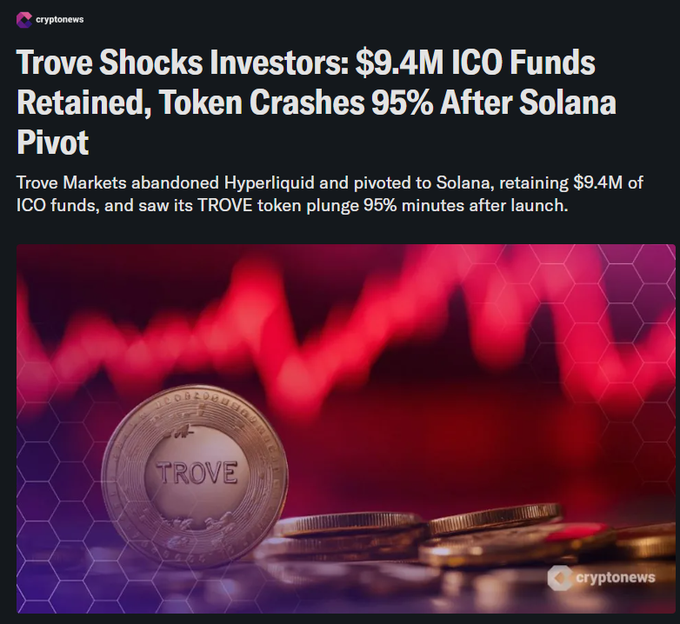
TROVE ($TROVE) is the most prominent recent example of an RWA-related token that crashed hard right after launch.
What Happened:
Launch Date: January 20, 2026 (TGE on Solana after originally planning Hyperliquid).
Pre-launch: Raised ~$11M+ via public ICO/presale.
Post-launch Crash: Dropped 95–97% within minutes to hours of trading.Expected FDV ~$20M at launch.
Plunged to under $1M FDV almost immediately (traded as low as ~$0.0005–$0.0008).
It was widely called one of the “worst launches of 2026” due to massive sell pressure, low liquidity on DEX, and heavy presale unlocks/selling.
Why Token-First RWAs Fail
The failure pattern is consistent.
1. No Real Liquidity Design
Listing a token is not the same as building a market.
RWAs require:
• continuous bid support
• redemption mechanisms
• depth across venues
Without this:
👉 price discovery breaks
👉 spreads widen
👉 confidence disappears
2. Mispriced Risk
Traditional finance prices:
• duration
• default risk
• yield expectations
Most RWA tokens ignore this.
They rely on:
• narrative
• fixed yields
• unsustainable incentives
The result:
👉 either underpriced risk
👉 or unattractive returns
Both kill demand.
3. Weak Redemption Mechanics
The entire premise of RWAs is:
👉 onchain access to offchain value
If users cannot redeem, exit, and trust the underlying.. Then the system fails.
A token without reliable redemption is not an asset… It is speculation.
4. No Institutional Alignment
Institutions care about these 3 things: compliance, transparency, and predictable liquidity
Most token-first designs optimize for:
• retail hype
• short-term flows
• TGE performance
This creates a mismatch. And institutions stay out.
Here’s a sample TOKEN LAUNCH STRATEGY FOR YOU:

Trireme on X: “Token Launch Strategy: Building What Works in Any Market Conditions” / X
What a Real RWA System Looks Like
The projects that win will not think like token issuers.
They will think like financial engineers.
1. Product First, Token Second
The underlying asset must stand on its own.
The token should optimize capital flow and improve its distribution.
Not replace the product.
2. Built-In Liquidity Architecture
Markets must be designed, not assumed.
This includes:
- Primary issuance
- Secondary liquidity
- Market-making structure
- Cross-venue depth
Liquidity is infrastructure , not marketing.
3. Clear Yield and Risk Framework
Returns must be:
• explainable
• sustainable
• competitive
This requires:
• proper risk modeling
• transparent cash flows
• alignment between holders and system
4. Redemption as a Core Feature
Every RWA must answer one question:
👉 How does capital exit?
Without a clear answer:
- price disconnects from value
- trust erodes
- liquidity dries up
Ondo Finance (ONDO) stands out as the best current example of a mature RWA project with comprehensive, production-ready systems in 2026.
Why Ondo is the Top Pick
- Scale & Adoption: Leads the RWA sector with ~$3.3B+ in distributed asset value / TVL (as of April 2026). It dominates tokenized U.S. Treasuries and has expanded into equities, bonds, and other instruments.
- Real Systems & Infrastructure (not just hype):
- Ondo Global Markets: Platform for issuing and trading thousands of tokenized RWAs with APIs for seamless integration.
- Ondo Chain: A dedicated public Proof-of-Stake Layer-1 blockchain built specifically for institutional-grade RWAs (compliant settlement, scalability, and security).
- Full-stack tokenization: Handles issuance, compliance (KYC/AML via legal wrappers and SPVs), custody, secondary trading, and on-chain yield distribution.
- Multi-chain deployment (Ethereum, Solana, etc.) with strong oracle integrations (e.g., Chainlink).
- Institutional partnerships: BlackRock (BUIDL collaboration), Mastercard, and others.
- Performance & Revenue: Generates significant real revenue (~$15M in early 2026 alone from RWA activities). High transparency and regulatory compliance.
The Market Is Starting to Differentiate
Capital is becoming more selective.
Early RWA experiments were driven by narrative.
The next phase will be driven by structure, performance, and reliability.
This is where most projects will fail.
Because building a financial system is harder than launching a token.
Final Insight
RWA is not a token narrative. It is a market structure shift.
The winners will not be the projects that tokenize assets.
They will be the ones that:
👉 rebuild financial systems onchain.
Trireme Perspective
This is where execution matters most.
RWAs require:
• liquidity engineering
• structured market design
• institutional-grade strategy
From pre-launch to post-listing: pricing, depth, distribution, and redemption must be all aligned.
Because in RWAs:
The token is not the product.
The system is.