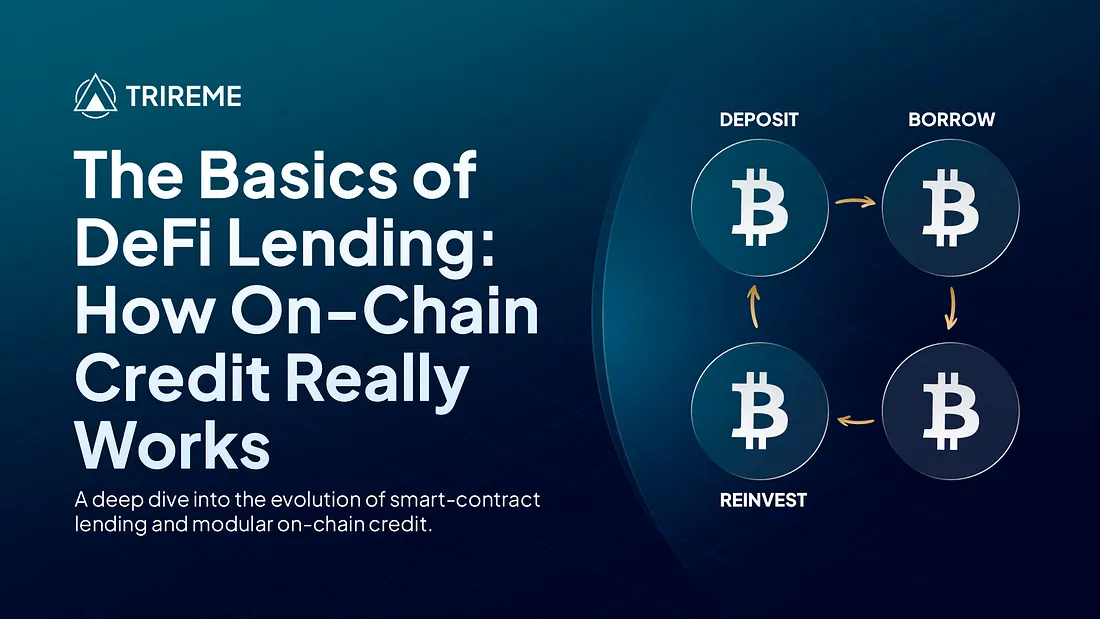
The Basics of DeFi Lending: How On-Chain Credit Really Works!
1. What Is DeFi Lending?
Lending is one of the earliest and most important primitives in decentralized finance (DeFi). Through smart contracts, users can supply assets to earn interest and borrow against collateral, all without intermediaries.
These loans are overcollateralized, meaning borrowers must deposit assets worth more than the amount they borrow, ensuring system solvency and reducing counterparty risk.
Every part of the lending process, from interest rate calculation to liquidation, is executed by smart contracts. This makes DeFi lending transparent, permissionless, and composable, turning it into a core building block that powers leverage, a powerful tool when used responsibly and with proper risk management.
Market Snapshot (29/10/2025)DeFi lending now holds roughly $79 billion in total value locked (TVL).
Aave remains the sector leader with about $39.1 billion, followed by Morpho with ~$8.3 billion .
2. The Evolution of Lending
From Shared Pools to Modular, Isolated Markets
Lending began with shared liquidity models like Compound and Aave, where users deposited assets into common pools and interest rates were determined algorithmically based on utilization.
These early systems were revolutionary, but they came with one key trade-off: pooled risk , if a market failed, it could potentially affect others.
Modern protocols like Morpho, Euler, and Kamino have evolved the design.
- Morpho introduced a hybrid model that pairs lenders and borrowers directly (P2P) while maintaining compatibility with Aave’s infrastructure. Each market on Morpho Blue is isolated with predefined risk parameters (loan-to-value (LTV) ratios, liquidation thresholds, and oracle sources) giving users higher efficiency (lower rates for borrowers and higher rates for lenders) and risk segregation.
- Euler took another innovative approach by connecting vaults instead of token pairs, allowing assets in one vault to serve as collateral for another. This vault-based architecture creates composable credit markets and more flexible borrowing structures.
- Platforms like Kamino have extended this approach on Solana, introducing correlation-aware oracles that prevent liquidations between highly correlated assets (like SOL vs. JitoSOL), making leveraged strategies safer and more predictable.
Overall, the trajectory of DeFi lending has been clear: from shared, monolithic pools to modular, risk-isolated credit markets that improve both riak management and capital efficiency.
3. Core Lending Strategies
a) Regular Lending & Overcollateralized Borrowing
The simplest use case: deposit assets to earn yield and use your collateral to borrow.
When you supply an asset, you receive a yield based on borrowing demand. If you also borrow against that collateral, your net interest cost is the difference between the lending yield and borrowing rate. In some cases — through looping strategies or liquidity incentives, as discussed later — this spread can even turn positive, meaning you can effectively borrow at near-zero cost.
However, this approach introduces liquidation risk.
Always monitor your LTV ratio and be aware of the correlation and volatility between the collateral and borrowed asset. If your collateral’s value drops or your borrow rate spikes, your position can be liquidated.
b) Long / Short Strategies
DeFi lending also enables simple directional trades using borrowing mechanics:
Deposit BTC, borrow USDC → short BTC.
If BTC’s price drops, you can buy it back cheaper to repay your debt, resulting in profit.
Deposit BTC, borrow ETH → long BTC, short ETH.
You’re effectively betting that BTC will outperform ETH.
This mechanism gives traders synthetic exposure to market movements without relying on perpetuals, all executed directly on-chain.
c) Leverage Lending & Looping
Platforms like Euler and Kamino support one-click leveraged lending, also known as looping.
Here’s how it works:
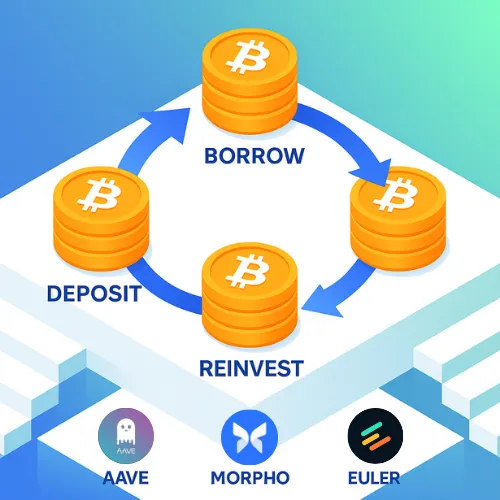
- You deposit collateral, for instance, a yield-bearing asset (e.g., stETH or JitoSOL).
- You borrow the non-yield-bearing version of that asset (e.g., ETH or SOL).
- You swap the borrowed asset back into your collateral asset and re-deposit it, increasing your collateral and therefore your borrowable amount.
- Repeat, each cycle (loop) increases your exposure to the yielding collateral.
This is effectively a carry trade:
If your deposit yields 5% and you borrow at 3%, you earn a 2% net spread per loop. With 5x leverage (five loops), your yield scales up to roughly 10%, assuming stable prices and funding costs.
Main risk → Liquidation
If your collateral value drops or borrowing rates spike, your position can be liquidated.
There are two main variations:
- Looping correlated assets (⬇ risk): (stETH/ETH or JitoSOL/SOL)
Because the assets move together, liquidation risk is minimal and with Kamino’s correlation-aware oracle system, liquidation between such pairs is effectively neutralized. - Looping uncorrelated assets (⬆ risk): (looping JLP/USDC or stETH/USDC)
JLP’s diversified composition (ETH, SOL, BTC + ~35% stables) helps reduce beta to the market, but you still face liquidation risk. Functionally, this type of loop behaves like a leveraged long/short position: you are long the collateral asset (whose value and yield you compound) and short the borrowed asset (whose value you owe).
Price divergence between the two determines profit or loss, if the collateral appreciates relative to the borrowed asset, the loop gains value; if it depreciates, the position faces amplified downside and liquidation risk.
In short, looping lets you amplify yield through leverage, but it also creates implicit long/short exposure when assets are uncorrelated.
d) Earn Layers and Vaults
For those who prefer a more passive approach, Vaults and Earn Layers offer professional-grade yield strategies with automated risk management.
Platforms like Morpho Vaults or Euler’s managed strategies allow curators to manage users’ deposits by allocating liquidity into specific lending markets or leveraging optimized strategies (like looping or stable lending).
The goal is to maximize yield while maintaining healthy collateral ratios and avoiding liquidation, abstracting the complexity away from the end user.
Vaults are increasingly popular because they allow users to benefit from DeFi’s advanced strategies without having to manage on-chain positions or monitor markets manually.
Risk Management: What Actually Matters
1. LTV, Liquidation Thresholds & Health Factor
Effective risk control in DeFi lending starts with understanding how much debt your collateral can safely support.
- Loan-to-Value (LTV) represents the ratio between your borrowed amount and the current value of your collateral. It defines the limit to how much you can borrow, a higher LTV means you’re using more of your collateral capacity and have less room before liquidation.
- The Liquidation Threshold (LLTV) is the maximum LTV allowed before your position becomes liquidatable. Each market sets its own threshold based on asset risk and liquidity profile.
- Health Factor (HF) measures how far you are from liquidation. An HF below 1 triggers liquidation.
2. Liquidity Risk & Slippage
Liquidity isn’t just about collateral value, it’s also about how easily you can exit or adjust a position.
- In low-liquidity markets or during periods of high volatility, slippage can widen spreads and make deleveraging expensive.
- Large positions can move the market when exited, pushing prices against you and accelerating liquidation.
3. Volatility & Correlation Risk
Price volatility and correlation between debt and collateral determines how quickly your LTV can change. The more volatile your collateral, the more buffer you need.
- High-volatility assets require lower target LTVs to remain safe.
- Correlation between collateral and borrowed assets is equally important. When they move in opposite directions, the collateral value can fall while debt value rises, rapidly worsening risk metrics.
4. Oracle & Market-Structure Risk
Accurate pricing is critical. Oracles that lag, fail, or pull data from illiquid pairs can cause wrongful liquidations or leave positions under-collateralized.
- Aave and Morpho both use decentralized oracle systems (typically Chainlink) to feed real-time prices.
- Morpho’s curator system allows each market to define its own oracle configuration and fallback feeds, offering flexibility but requiring users to verify the reliability of those sources before depositing.
5. Negative Carry & Yield Compression
In looping or leveraged lending strategies, the carry trade or the difference between what you earn on supplied assets and what you pay on borrowed ones, can turn negative when conditions shift.
- A rise in borrowing costs, a drop in supply yields, or declining token incentives can erode profitability.
- Continuous monitoring of looping positions is therefore key to avoid unexpected losses.
Conclusion
Lending may be one of DeFi’s oldest primitives, but it remains one of its most vital. Evolving from simple pooled models like Aave to modular, risk-isolated frameworks such as Morpho and Euler, lending has become the foundation for advanced strategies, protocol innovation, and new sources of on-chain yield.
Written by Iván Kyrian De la Horra of Trireme.
Link for reference: https://medium.com/@ivankyrian.fi
At Trireme, we collaborate with DeFi protocols, liquidity layers, and tokenized credit systems to design sustainable market structures that bridge institutional and on-chain finance.
Our work spans liquidity architecture, risk modeling, and strategic market support for projects reshaping how capital moves in Web3.
If you’re building in the DeFi, RWA, or liquidity infrastructure space — let’s connect.
Visit www.trireme.com to learn how Trireme helps projects grow through liquidity design, fundraising, and go-to-market execution.