The Coldcard Hacking: What Went Wrong and What Projects Should Learn

Independent technical commentary based on public information and third-party analysis. Findings, attribution and incident totals may change. This article is not cybersecurity, technical, legal or financial advice. Potentially affected users should consult current official vendor guidance and qualified specialists.
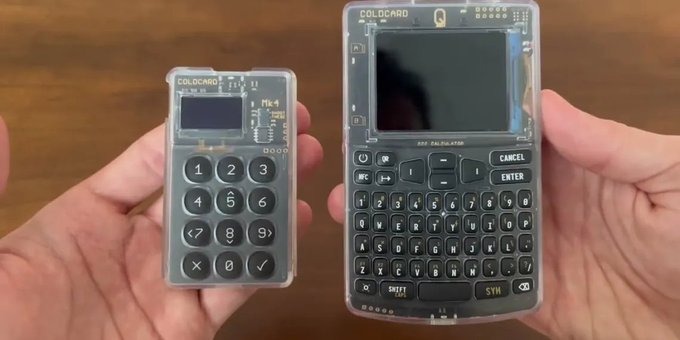
Hardware wallets are designed to keep private keys away from internet-connected devices. But that protection depends on a more fundamental assumption: the keys must have been generated with enough genuine randomness in the first place.
The reported Coldcard incident shows what can happen when that assumption fails.
According to the technical and on-chain analysis supplied for this article, a firmware integration error introduced in 2021 caused certain Coldcard devices to generate wallet seeds using substantially less entropy than intended.
Instead of drawing fully from the board-specific hardware True Random Number Generator, the affected seed-generation path reportedly resolved to a software pseudorandom number generator seeded from a limited set of device and timing information.
The hardware wallet remained offline. Its physical protections remained relevant. The seed could still be backed up and transactions could still be signed on the device.
But the secret protecting the wallet may already have been too predictable.
This distinction matters. The reported attacker did not necessarily need to steal a device, obtain a backup or intercept a transaction.
With a sufficiently reduced search space, possible seeds could reportedly be generated and tested offline against funded addresses already visible on the Bitcoin blockchain.
The vulnerability therefore appears to have existed from the moment an affected seed was created - potentially years before the funds moved.
The Reported Root Cause
The supplied technical analysis traces the issue to a cryptographic-library migration introduced around March 2021.
As part of that change, the path used to generate a new wallet seed reportedly moved from Coldcard’s board-specific hardware-randomness function to a function exposed through the integrated library.
A configuration flag was defined with a value of zero to disable MicroPython’s standard hardware-randomness path. However, the relevant integration guard allegedly checked only whether the flag had been defined, rather than whether it had been enabled.
That difference is subtle but important:
- a test for whether the flag exists will pass even when its value is zero;
- a test for whether the flag is enabled should evaluate its actual value;
- the resulting build reportedly resolved the random-number request to MicroPython’s software fallback rather than the intended hardware source.
According to the supplied analysis, the device’s hardware-randomness implementation remained in the firmware and continued to serve other functions. The failure was narrower and more consequential: it allegedly did not protect the path responsible for generating the master wallet seed.
Coldcard’s current documentation describes a different intended design. It says modern devices primarily use a hardware True Random Number Generator, mix additional pseudorandom input into it and process the result through SHA-256. It also allows users to add independent dice-roll entropy.
Source: https://blog.coinkite.com/entropy-technical-backgrounder/
Why Entropy Determines Wallet Security
A wallet seed is not protected because its words look random. It is protected because the number of possible seeds is so large that searching through them is computationally impractical.
A correctly generated 12-word BIP-39 seed normally represents approximately 128 bits of entropy before its checksum is added.
That creates a search space far beyond practical exhaustive enumeration.
The supplied technical analysis estimates that the affected implementations provided materially less effective entropy:
- approximately 40 bits for certain Mk2 and Mk3 firmware versions;
- approximately 72 bits for certain later models running pre-fix firmware.
Those estimates require technical confirmation before publication. But the difference in scale explains the reported attack model.
A 40-bit search space contains roughly 1.1 trillion possibilities. That remains substantial, but it is fundamentally different from the approximately 3.4 × 10³⁸ possibilities represented by 128 bits.
A 72-bit space is much larger than 40 bits, yet still vastly smaller than the security level users would expect from a correctly generated seed.
An attacker who understood the limited entropy sources could potentially:
- reconstruct or approximate the possible software-randomness states;
- enumerate candidate seeds;
- derive addresses across common wallet paths;
- compare those addresses against the public Bitcoin blockchain;
- identify funded single-signature wallets; and
- sweep the funds without ever accessing the physical device.
The blockchain becomes the attacker’s lookup table. Candidate secrets are generated privately; public addresses reveal which candidates are worth targeting.
What the On-Chain Pattern Reportedly Showed
The initial analysis identified 1,196 addresses swept for approximately 1,082.65 BTC within a 41-minute period on 30 July 2026.
Subsequent updates attributed two further waves to the same apparent method. By the reported 1 August cutoff, the observed total had reached approximately:
1,367.05 BTC across 4,585 addresses
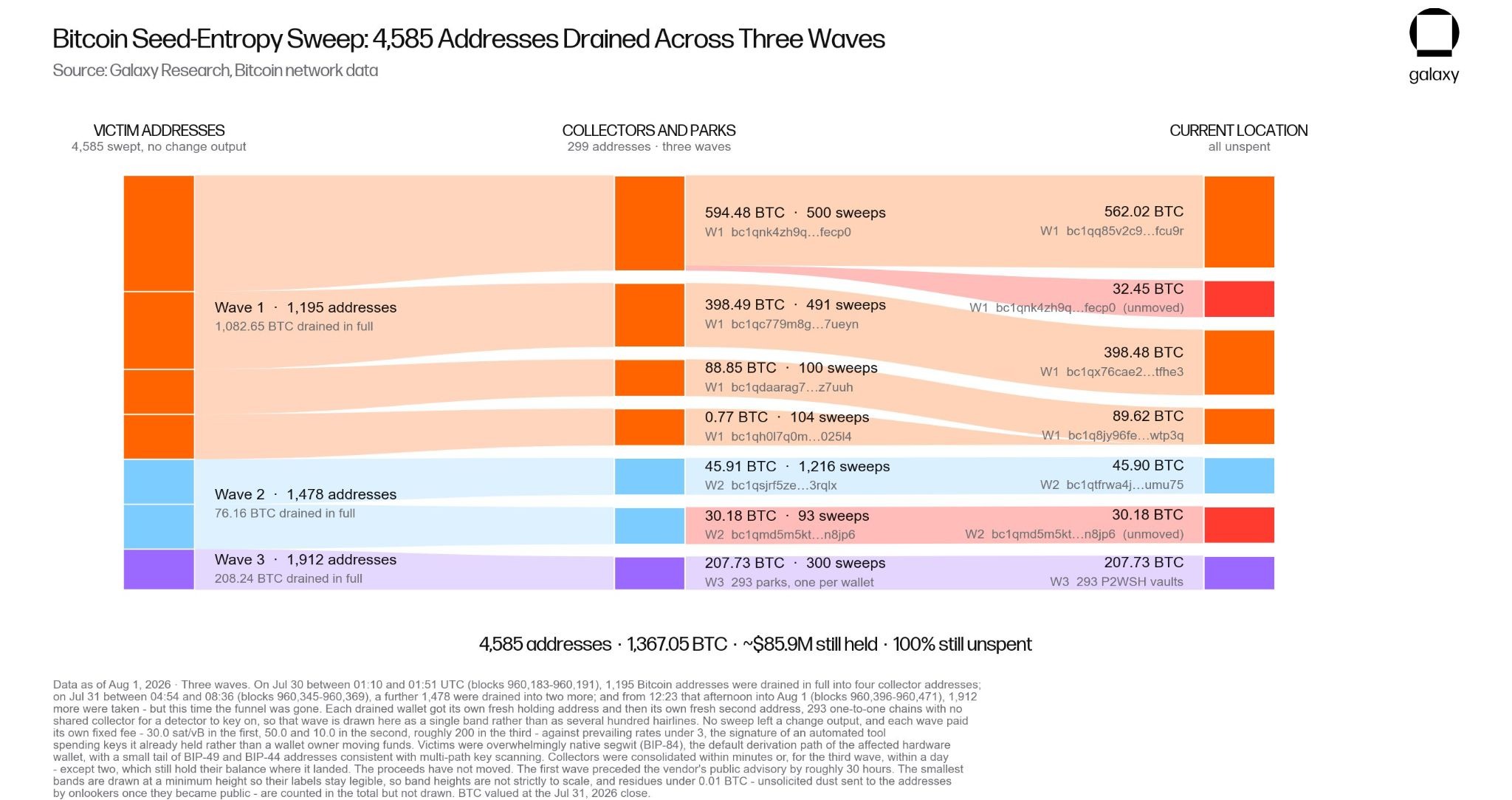
The value was estimated at approximately $88.6 million at that point.
These totals remain subject to revision. On-chain attribution can produce false positives or miss affected addresses, particularly where ownership, wallet software and seed-generation history cannot be conclusively established from public transactions alone.
Nevertheless, the supplied analysis identifies several recurring features:
- wallets were swept completely;
- early transactions used the same hardcoded fee rate;
- the fee rate was reportedly far above prevailing network conditions;
- many transactions created no change output;
- addresses from several standard derivation paths were affected;
- proceeds were consolidated rapidly;
- the tracked funds had largely remained unspent at the observation cutoff.
That behaviour is more consistent with an automated system spending keys it already possessed than with thousands of unrelated users independently moving funds at the same time.
It also suggests that the attacker may have searched multiple common address derivation paths rather than targeting one wallet configuration alone.
The analysis reportedly found no affected funds created before the approximate block corresponding to the March 2021 firmware change.
That timing is potentially important, but it should be treated as supporting evidence rather than conclusive proof of causation.
The Security Boundary Failed Earlier Than Expected
The most important conclusion is not that hardware wallets are ineffective.
It is that a hardware wallet can protect only the key material it has been given.
Secure elements, air gaps, PIN protections and transaction verification can all reduce meaningful risks. None can transform a weak master seed into a strong one after it has been generated.
This changes how custody teams should think about the security boundary.
The obvious attack is visible at the end of the process: an unauthorized transaction appears and funds leave the wallet.
The actual failure may occur much earlier:
- during entropy collection;
- during firmware compilation;
- at a library boundary;
- in a configuration flag;
- during seed generation;
- or when an organization accepts a device-generated seed without independent assurance.
By the time the funds move, the decisive security failure may be years old.
Updating Firmware Does Not Repair an Existing Seed
A firmware update may correct the process used to generate future seeds. It does not increase the entropy of a seed that has already been created.
That distinction is operationally critical.
According to the supplied remediation information, a potentially affected user would need to generate an entirely new seed using corrected firmware or another independently trusted process and then migrate funds to addresses derived from that new seed.
Continuing to use an existing weak seed after updating the device would preserve the original vulnerability.
No reader should act solely on this article. Anyone who may be affected should consult the latest official manufacturer notice and obtain appropriate specialist assistance.
Firmware files should be obtained from the official source, matched to the correct model and independently verified before installation; Coldcard’s current instructions specifically recommend checking firmware hashes and signed release information.
Why Some Wallets May Have Survived
The supplied analysis identifies three controls that may have protected some users even where vulnerable firmware was involved.
Independent dice-roll entropy
Coldcard allows users to add physical dice rolls when creating a seed. Sufficient truly independent rolls can supply entropy that does not depend on the device’s internal generator.
Coldcard’s current documentation estimates approximately 2.5 bits of entropy per dice roll and cautions that the rolls must be genuinely random rather than deliberately selected by the user.
The reported protection should not be reduced to a casual instruction to “add a few rolls”. The number of rolls, their independence and the way they were incorporated all matter. The supplied analysis refers to at least 50 independent rolls, but that threshold should be confirmed against the formal incident guidance.
A strong, unique BIP-39 passphrase
A BIP-39 passphrase derives a different wallet from the underlying seed. A sufficiently strong and unique passphrase can add a separate secret that is not recoverable from the seed alone.
Coldcard’s current documentation confirms that each exact passphrase selects a different wallet and that a forgotten passphrase cannot be recovered from the seed.
This protection depends on passphrase quality. A short, reused or predictable phrase may itself be searchable. It also introduces recovery risk: losing the passphrase permanently loses access to the corresponding wallet.
Multisignature custody
In a properly designed multisignature arrangement, compromising one key does not necessarily authorise a transaction.
A vulnerable Coldcard-generated key may therefore have been insufficient on its own where the spending policy required additional independently generated signatures.
Multisig is not an automatic cure. Its value depends on genuine independence between keys, devices, firmware, operators and backups.
Several devices generated through the same vulnerable process could create correlated risk rather than meaningful redundancy.
What Treasury Teams Should Do Differently
The incident points to a broader institutional lesson: custody should be governed as a system, not selected as a product.
A treasury-security review should cover at least five layers.
1. Seed provenance
Teams should know:
- when each seed was generated;
- which model and firmware generated it;
- which entropy sources were used;
- whether independent entropy was added;
- and whether any later disclosure affects that process.
A recovery phrase without provenance is an operational blind spot.
2. Independent signing controls
No material treasury should depend on a single key merely because that key is stored offline.
Signer architecture should consider:
- multisignature thresholds;
- independent device and vendor exposure;
- separation of operators;
- transaction limits;
- approval policies;
- and emergency migration procedures.
3. Firmware and supply-chain assurance
Teams should maintain a record of:
- device models;
- firmware versions;
- verified firmware hashes;
- update history;
- security notices;
- and retirement decisions.
Firmware verification is not merely an installation step. It is part of the custody audit trail.
4. Continuous address monitoring
Cold storage should not mean unmonitored storage.
Treasury addresses can be monitored without exposing private keys. Alerting should cover:
unexpected outbound transactions;
- unusual fee behaviour;
- consolidation patterns;
- dormant-address movement;
- and relevant vendor disclosures.
Monitoring cannot prevent an attacker who already possesses the key, but it can reduce detection time and inform coordinated response.
5. A rehearsed migration plan
A security disclosure is the wrong time to decide how a treasury will move assets.
Teams should know in advance:
- who can declare an incident;
- which clean signers and destination wallets are available;
- how a migration will be authorised;
- how counterparties will be notified;
- and how evidence will be preserved.
The operational goal is not to improvise perfectly. It is to avoid improvising at all.
The Wider Leadership Lesson
This reported incident was not primarily a failure of transaction signing. It was reportedly a failure of randomness, integration and assurance.
A single implementation detail may have reduced an enormous cryptographic search space to something an attacker could explore offline.
The devices could remain physically secure while the secret at the centre of their security model was already vulnerable.
That leads to a more demanding definition of self-custody.
Self-custody is not simply possession of a device or a recovery phrase. It is the ability to establish confidence in how keys were generated, how they are protected, what is required to use them and how the organisation will respond when one layer fails.
For founders, funds and treasury teams, the central question is therefore not:
Which hardware wallet do we use?
It is:
Can we verify and defend every stage of the key lifecycle?
Hardware remains important. But secure custody begins earlier - with entropy, implementation and key generation - and extends further, through signer design, monitoring, recovery and incident response.
The transaction was the visible loss. The reported security failure began when the seed was created.
Important Notice
This article is provided solely for general informational and educational purposes and is intended primarily for professional, institutional and technically sophisticated readers. It does not constitute cybersecurity, technical, legal, financial, investment or other professional advice and should not be relied upon as a substitute for independent specialist assessment.
The article is based on publicly available information, third-party technical analysis and public blockchain data available as of the publication date. Incident totals, affected devices or firmware versions, technical findings, attribution and remediation guidance may be incomplete, disputed or subsequently revised. Unless expressly stated otherwise, Trireme has not independently audited the relevant firmware, reproduced the reported vulnerability or verified ownership and attribution for every address discussed.
References to Coldcard, Coinkite, Galaxy Research, Block or any other third party are included solely for factual attribution and context. They do not imply affiliation, partnership, sponsorship or endorsement. All names, trademarks and logos remain the property of their respective owners.
This article does not determine fault, liability or legal responsibility on the part of any person or organisation. Readers who believe they may be affected should consult the latest official vendor communications and obtain assistance from appropriately qualified cybersecurity, custody and legal professionals before taking action.
Technical observations and potential mitigations discussed in this article are illustrative only. They should not be implemented in a production or treasury environment without independent verification, testing and specialist review. Firmware updates may not remedy weaknesses in seeds generated previously; readers should rely on current official instructions applicable to their specific device and circumstances.
Cryptoassets and self-custody arrangements involve substantial risks, including cyberattack, compromised keys, operational error and permanent loss of assets. Trireme makes no representation or warranty as to the accuracy, completeness or continued availability of the information and has no obligation to update it.